
25th January 2025

The Minister for Health confirmed this week that there is indeed very significant spare capacity in the South West Acute Hospital (SWAH).
SOAS welcome this statement from the Minister which acknowledges what has been highlighted by SOAS as part of their research.
The information was confirmed by the Minister for Health in a written response this week to an assembly question (AQW 20003/22-27) tabled by Daniel McCrossan, MLA for West Tyrone.
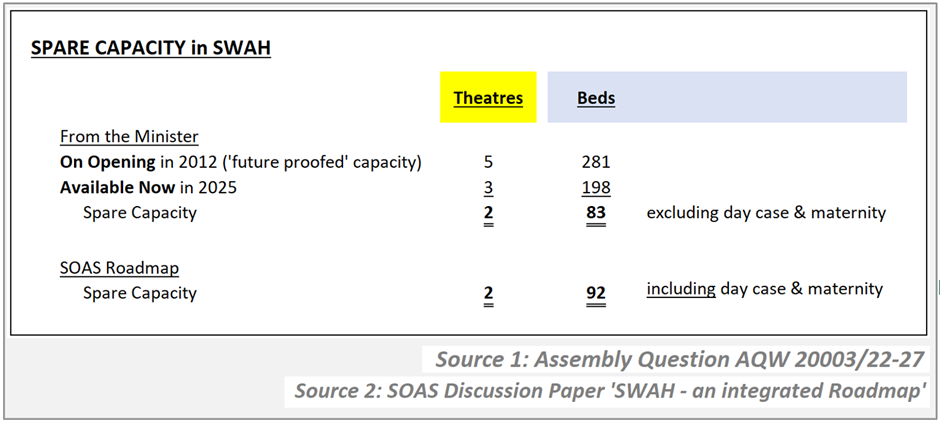
The ministerial figures confirm that there are two operating theatres in SWAH which have never been commissioned. It also confirms that there are 83 beds in SWAH which have never been used.
Importantly, this aligns with the SOAS discussion paper ‘SWAH – an integrated Roadmap’ which was launched last week – available at https://bit.ly/3BYflgL. This confirms 2 uncommissioned theatres and 92 uncommissioned beds.
The slight difference in the number of commissioned beds is down to the fact that SOAS figures include maternity and day case, which the ministerial figures do not.
The minister in his written answer states that these unused beds and theatres are essential to ensure maximum ‘future-proofed’ capacity for SWAH.
This future proofing aligns with the goal of the SOAS discussion paper to ensure a long-term sustainable future for all services, including emergency surgery, in SWAH.
The SOAS discussion paper presents a positive future for the entire South West region with regard to healthcare. We call on the Department of Health to commission this spare capacity immediately to ensure SWAH can contribute fully in the effort to get waiting lists down.
We have heard many comments – including from the minister himself – over the last number of months that there is no available capacity anywhere in the hospital network. This statement today confirms that there is in fact a substantial amount of capacity – across both beds and theatres – in SWAH.
It is acknowledged that our waiting lists are out of control. The plans from the Department of Health in their Elective Care Framework increasingly point to more and more use of independent private companies.
The available capacity in SWAH presents a genuine opportunity to kickstart an NHS-led accelerated elective program in SWAH using NHS staff.
One of the key drivers for the original business case for SWAH in 2009 was to enable significant activity to come in from across the central border areas. This North-South activity is key to ensuring a sustainable future for the hospital. It will also lead to improved health outcomes for local communities on both sides of the border. We welcome the Minister’s statement on 1st October when he stated in Stormont that “SWAH was built on the basis of cooperation across the border.”
We also welcome the comment from the minister that the uncommissioned theatre space is being actively used by private companies at present. This means that the theatres are ‘ready to go’ should a decision be made to develop NHS-based elective activity in SWAH.

The assembly question – shown above – refers to a ‘report from Save Our Acute Services that 100 potential beds at the South West Acute Hospital are not being used’.
The SOAS report referred to ‘occupied’ beds.
The Department of Health figures confirm that there were on average 25 beds in SWAH last year that were available but not ‘occupied’.
It is clear that adding these 25 unoccupied beds to the ministerial figure of 83 beds indicates that 108 beds in SWAH are not being used. This excludes day case and maternity beds. The SOAS figures which include day case and maternity put the figure of beds not being used at 117 beds.
